Data cables found inside the computer connect multiple devices together through the motherboard. Cables usually connect HDDs, optical disk drives and floppy drives to the motherboard.
There are two main types of cables inside a computer there are IDE and SATA. IDE and SATA connect both HDDs and optical disk drives to the computer.IDE is a ribbon of wire which is usually grey in colour and has large connectors at each end it is an older wire which is being replaced by Serial ATA which is a thin red colour wire which has a small connector. Both of these wires carry data at the same speed.
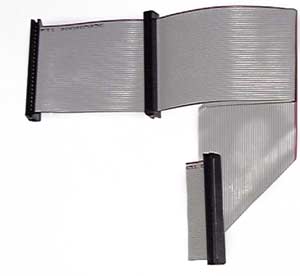
IDE cable
(Image Source: http://www.eurotronix.com/)
External Cables
There are many external cables these cables connect external components to the internal components.
There are cables which have USB connections USB has two types USB 1.1 and USB 2.0, the USB 1.1 has a transfer speed of 12 Mbps whereas USB 2.0 has a 480 Mbps transfer speed. There is also Fire wire cable which has two kinds. Fire wire 400 and Fire wire 800 which transfer speeds are 400 Mbps and 800 Mbps.
.jpg)
USB Cable
(Image source: http://www.danmeter.dk/)
There are also multiple kinds of video cable to output what the computer is doing. There are three types of video cable VGA, DVI and HDMI, VGA and DVI do not carry sound they purely produce the image. VGA is an analogue connection which does not carry sound, it was originally used to connect CRT monitors to the computer. DVI is a digital connection which has two types DVI-Digital (DVI-D) and DVI-Integrated (DVI-I). DVI-D can only be used with a digital output device whereas DVI-I can also carry an analogue signal.

DVI-I Cable
(Image source: http://www.cablek.com/)

Nice Explanations to go with the pictures
ReplyDeleteGives good information about different types of cable
ReplyDeleteI like the info as well as the pictures you have posted well done!
ReplyDeleteGood information with pictures.
ReplyDelete